Our first stop was Yoyogi Park, a large park and home to the Meji Shrine.
This is the gate to the park near Harajuku subway station entrance.

I don't know if you can tell, but they were thrilled to be there. Nothing like the forced self-guided tour.
Further into the park

It reminded me of Point Pleasant Park in Halifax, pre-Hurricane Juan. There are 100, 000 trees from Japan and other countries planted in this park. The trees were planted 90 years ago to honour Emperor Meiji and his wife, Empress Shoken, beloved, progressive rulers from 1852-1912.
Deeper still into the park

Wine barrels!
Yes, this is the park for all you oenophiles. To the best of my understanding, these were given to Japan by wine makers of Burgundy as an act of friendship and peace.
Emperor Meiji was a proponent of Western culture and French wine was a part of his appreciation. Smart man. This also explains the subtle French influence I saw, like the bakeries, the fashion, the cafes.
On the other side, there were these things.

I haven't a sweet clue what these are. Truly. They looked like bales of something. That's useful.
Any ideas, anybody?
Here's a close-up if that helps.

Closer still...

Somebody out there has to know what these are!
We walked on to the Meiji Shrine.

This is a serious gate. The Torii, or Shrine Gate, made from cypress.
Before one enters a Shinto shrine, like the Meiji, there is a whole series of steps to follow to pay proper respect. The second to fourth steps of ten involve rinsing with water.

Visitors performing their ablutions.
"But wait!" I hear you say, "What is Shinto?"
Shinto is Japan's ancient original religion and it is deeply rooted in the Japanese way of life [she plagiarizes boldly from the park brochure]. Shinto has no founder and no holy book. Shinto values harmony with nature and virtues such as a "sincere heart". In Shinto, some divinity is found in Kami (divine spirit), of which there are an unlimited number. You can see Kami in mythology, nature and in human beings [like Emperor Meiji and Empress Shoken]. From ancient times, Japanese people have felt awe and gratitude towards such Kami and dedicated shrines to many of them [finished my blatant copying from the brochure].
The entrance to the shrine courtyard

From another angle


Before I went in, I was distracted by this bridal party making use of the Shinto marriage hall and grounds for their wedding day. Beautiful!
I followed them to where their photos were being taken.

I felt so lucky to have been a witness to this aspect of daily Japanese life.
Back to the shrine...the inner active area.


People were beginning to leave, including this Shinto priest.


She was clearly at the shrine for a special event.

Everybody's cleared out.

Building bordering one edge of the courtyard.

Looking across the courtyard. I love their outfits!


This was something I had never seen before, these rows and rows of dolls and stuffed animals that went around four walls of an area set back from the main courtyard. There were so many different varieties. Some of the dolls were stunning.
I did some research on the meaning of all these thank dolls and this is what I came up with. If I am wrong, someone please let me know.
First of all, you need to know that dolls play a huge role in Japan's culture, even today.
From a website, not mine:
Japanese Dolls
Japanese Dolls are renowned in the world and are an integral aspect of the culture of Japan. The Japanese traditional dolls are known as 'ningyo', which means 'human figure'. Different types of dolls are available in Japan ranging from warriors and heroes, fairy-tale characters, gods and (rarely) demons and commoners. These dolls are made for gift purpose, for household shrines and to be used during festivals like Hina Matsuri [the Doll Festival]. The dolls are also popular souvenirs of Japan, which are frequently bought by the tourists visiting the country.The tradition of dolls in Japan goes back to the ancient past, when the young girls played with dolls and dollhouses. Women of Japan used to make dolls to protect their children or grandchildren and dolls were also used in religious ceremonies.
Information on what these dolls and stuffed animals are doing at the Meiji Shrine:
CEREMONIES TO SAY 'THANKS AND GOODBYE'
Last rites for the memories as beloved dolls pass away
Staff writer
Earlier this year, Okamoto was excited to learn about the Kiyomizu Kannondo Temple in Tokyo's northern Taito Ward. At that temple in Ueno Park, she found out that a ceremony called ningyo kuyo is held annually to pray for dolls and thank them for giving their owners many fond memories. It is also a way for owners to release dolls from their hands and lives.
On Sept. 25, Okamoto was one of many dozens who took their dolls to the temple to be prayed for and then discarded. They included traditional ones such as Hina ningyo doll sets representing emperor and empress, attendants, court musicians and guards, which are traditionally given on the March 3 annual Hinamatsuri (Doll Festival), when families with daughters display them as a way of expressing hope for their future happiness. As well, that day at the temple, numerous soft-toy animals or animation characters were among the many "offerings" made.
In fact, one of the nation's major "doll farewells" takes place today at Meiji Shrine in Tokyo's Shibuya Ward. There, from 9 a.m., people will start bringing in their dolls, and a huge number are expected to surround the main shrine before the day is out.
All very touching, for sure, but why do so many Japanese feel the need to pray for the dolls before abandoning them -- to say such "Thanks and Goodbye," as signs at Meiji Shrine proclaim?
According to Sumie Kobayashi, who heads the reference room of doll manufacturer Yoshitoku Co., the key actually lies in the annual Hinamatsuri Doll Festival. The dolls for this occasion, traditionally representing the wedding of the Imperial couple, are displayed on a platform. They are admired and handled with care and respect.
If you want the full story, here's the web address. I really encourage you to do so. It's a fascinating, easy, informative read and the pictures are lovely.
http://search.japantimes.co.jp/cgi-bin/fl20061015x1.html
Back to our day. Walking out of the park, we saw one more family celebrating a special event. I don't know what, but I bet it had something to do with the little girl, who graciously allowed me to take her photo.

You know what? I edited this one in iPhoto and it didn't "take". I still need technical help! Oh, well. Do your own cropping using your fingers.
The girl's hair-do is priceless.
We left the shrine and park (Finally! I can my family say), leaving by the same entrance we came in, the one close to the Harajuku subway entrance.




You know what? I edited this one in iPhoto and it didn't "take". I still need technical help! Oh, well. Do your own cropping using your fingers.
The girl's hair-do is priceless.
We left the shrine and park (Finally! I can my family say), leaving by the same entrance we came in, the one close to the Harajuku subway entrance.

Side view of Tudor style station, Tokyo Tower blocked by station tower
Good job, Elizabeth

Front view
Most important view we had, some classic Harajuku girls-in-training. We saw more extreme examples, but they wouldn't let me take their photos. These ones needed the practice holding their fingers in the Asian "V", I guess. Actually, they were really sweet.

Talk about cross-cultural cuteness!
After this photo op, we made our way to Takeshita Dori (Street) which is the centre of Tokyo's most extreme teenage fashion.

Looking down Takeshita Dori

Checking out the merchandise. Now we're happy!

Hey! Now I can be a goth Lolita Harajuku girl.
Rakesh was thrilled.

Time for lunch to keep up the strength needed for shopping.
Yes, waffles again, with Dr. Pepper, no less. I am a bad mother.
At least Hare is integrating with the local population. Notice the subtle "V" sign?

We weren't the only ones shopping on Takeshita Dori.

And shopping....

... and shopping here, tee hee.
After the kids had done their bit to boost the Tokyo economy, it was my choice of activity again and I chose monorail. Did someone say, "Monorail'? Anyone else see that "Simpson's" episode? Never mind.
Yes, we went on the Yurikamome monorail. It was a great way to see another part of the city, sitting down (always a bonus).

The Rainbow Bridge reminiscent of the Halifax/Dartmouth bridge

This is definitely a ringer for Halifax.

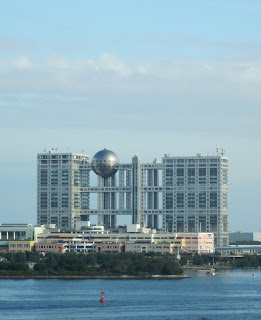
The FUJI TV Headquarters with its globe-shaped observatory open to the public.

Formula One cars on display. Very cool.
Yes, we could see them from the elevated monorail.

Fountain in the midst of office buildings

Ferris wheel in the colourful Palette Town

Random gigantic saw.
Tool Town?

My attempt to take a picture proving we were on a monorail.
At least there is unique building in the distant background.

Tokyo's version of Toronto's Leslie Street Spit.
Beautiful. What a fabulous city.
Tokyo Tower visible to the left, a tall ship to the right.
We finished our monorail loop, went back to the hotel, rested and then went out for dinner which wasn't "blog-worthy".
This should have been a premonition of what was to come in the evening.

Not really, but I wanted to post this photo in a clever way. Vivian is definitely the Fury.